

Enshrined Deities
Taizan Fukun Okami (Taiitsu / Taiichi)
The principal deity of Tensha Shrine is Taizan Fukun Okami (泰山府君大神). From ancient times, this deity has also been revered by the names Taiitsu (太一) and Taiichi (泰一), as the great deity at the beginning of the myriad kami.
Taiitsu is a sacred name expressing the source of all things, including the deities of Heaven and Earth. In Shinto, it has been honored as the fundamental principle from which yin and yang, the Five Phases, the sun, moon and stars, and the cycle of the four seasons all arise. The yakudoshi, or critical years of life, transmitted at shrines and temples throughout Japan are also understood as determined by this cycle of Taiitsu and were traditionally called “the critical years apportioned by Taiitsu.”
In Heaven, Taiitsu is manifested through the North Star at the center of the sky and the Big Dipper revolving around it. The North Star establishes the axis of all phenomena as the pivot of Heaven, while the Big Dipper turns its handle and announces the four seasons. Together, these two workings have been revered as the heavenly form of Taiitsu.
On Earth, Taizan Fukun Okami—the very presence of Taiitsu—is the deity of Mount Tai, which communicates with Heaven. In China, Mount Tai has long been revered as the foremost sacred mountain, the mountain guarding the east, and the place to which the spirits of the dead return and gather.
From ancient times, only a ruler who had received the Mandate of Heaven was permitted to build an altar at the summit of Mount Tai to worship Heaven and to worship Earth at a smaller mountain below. This rite is called Fengshan (封禅). The Records of the Grand Historian relates that seventy-two rulers had worshiped Heaven at this mountain since the age of the gods, including the Yellow Emperor, Yao and Shun. In recorded history, rulers such as the First Emperor of Qin and Emperor Wu of Han performed this great rite. Emperor Xuanzong of Tang also performed Fengshan at Mount Tai in 725 and bestowed upon the deity of the mountain the title Tianqi Wang (天斉王), “King Equal to Heaven.” Such was the depth of reverence for the mountain connected with Heaven and for its deity.
According to the history preserved at Tensha Shrine, the sacred object of Taizan Fukun Okami—also called Dayuanzunshen (大元尊神)—was transmitted more than 1,300 years ago. Through a sacred event associated with Abe no Nakamaro, who traveled to Tang China as a member of a Japanese mission, it passed from Kibi no Makibi to the Kamo and Abe families and was later enshrined by the Tsuchimikado family.
Until the Meiji Restoration, the Tsuchimikado family served the Imperial Court as the hereditary head of Onmyodo and as the family responsible for observing the heavens. Enshrining Taizan Fukun Okami, they conducted rites praying for the peace of successive imperial reigns and the tranquility of the nation. It was also their important hereditary duty to distribute the divine qi of Taiitsu through the calendar and convey the movements of Heaven to the human world.
This tradition of rites and calendrical practice continues unbroken at Tensha Shrine today.
The Twelve Deities of Tensha (The Seven Generations of Heavenly Deities)
Before Heaven and Earth were divided, there was one divine qi. In Shinto, this divine qi, the source of all things, is revered as Taiitsu. The name is also written in large characters upon a banner during the periodic rebuilding rites of Ise Jingu.
At the creation of Heaven and Earth described in the Nihon Shoki, Heaven and Earth separated and the kami appeared in Takamagahara, the Plain of High Heaven. The divine qi of Taiitsu first divided into yin and yang. From yin and yang arose the Five Phases of wood, fire, earth, metal and water, and through their workings the world took form.
Emperor Tenmu initiated the compilation of the Nihon Shoki. He was himself deeply versed in the way of yin and yang: he practiced astronomy and tonko divination, built an astronomical observatory and established the Onmyoryo. It is therefore meaningful that the chronicle begins with the primordial state before Heaven and Earth had separated and before yin and yang had divided. To revere the kami of Japan through the principles of yin, yang and the Five Phases is a reading rooted in the Nihon Shoki itself.
The Nihon Shoki calls the seven generations from Kuni no Tokotachi no Mikoto, the first to appear, through Izanagi no Mikoto and Izanami no Mikoto the Seven Generations of Heavenly Deities. Another account relates that Ame no Minakanushi no Kami, Takamimusubi no Mikoto and Kamimusubi no Mikoto arose in Takamagahara.
Ame no Minakanushi no Kami and Kuni no Tokotachi no Mikoto are two names of the same deity—Taiitsu, Dayuanzunshen. At Tensha Shrine, these deities, together with Takamimusubi no Mikoto and Kamimusubi no Mikoto, are revered as the first generation. The twelve kami from the first through the sixth generations are honored as the Twelve Deities of Tensha.
First Generation
- Ame no Minakanushi no Kami (天御中主神)—Taiitsu, Dayuanzunshen
- Kuni no Tokotachi no Mikoto (国常立尊)—Taiitsu, Dayuanzunshen
- Takamimusubi no Mikoto (高皇産霊尊)—Deity of primordial qi, fire and yang
- Kamimusubi no Mikoto (神皇産霊尊)—Deity of primordial qi, water and yin
Second Generation
- Kuni no Satsuchi no Mikoto (国狭槌尊)—Deity of primordial qi and the virtue of water
Third Generation
- Toyokumunu no Mikoto (豊斟渟尊)—Deity of primordial qi and the virtue of fire
Fourth Generation
- Uijini no Mikoto (埿土煮尊) and Suijini no Mikoto (沙土煮尊)—Deities of primordial qi and the virtue of wood
Fifth Generation
- Otonoji no Mikoto (大戸之道尊) and Otomabe no Mikoto (大苫邊尊)—Deities of primordial qi and the virtue of metal
Sixth Generation
- Omodaru no Mikoto (面足尊) and Kashikone no Mikoto (惶根尊)—Deities of primordial qi and the virtue of earth
Seventh Generation
- Izanagi no Mikoto (伊弉諾尊)—Yang deity; deity who brings yin, yang and the Five Phases to completion
- Izanami no Mikoto (伊弉冉尊)—Yin deity; deity who brings yin, yang and the Five Phases to completion
The two deities of the seventh generation, Izanagi no Mikoto and Izanami no Mikoto, brought the workings of yin, yang and the Five Phases to completion and gave birth to the land and the kami. In time, Amaterasu Omikami was born and came to rule Takamagahara.
The deities of the virtues of water and fire arose as solitary deities, while those of wood, metal and earth arose as paired deities of yin and yang. This is the form of the solitary and paired births of the kami transmitted in the Nihon Shoki.
One aspect of these workings of the Five Phases can also be seen in the ancient tradition that the myriad kami gather at Izumo for divine council in the tenth month of the traditional calendar—the month of the boar, assigned to the qi of water. Water stores all things within itself and carries the potential for what will next come into being.
The workings of the Japanese kami are not separate from the cycle of wood, fire, earth, metal and water. The kami manifest the divine qi circulating through Heaven and Earth as their respective virtues: calming the world, joining bonds, turning the seasons, and giving life and nurture to all things.
The Twelve Deities of Tensha are manifestations of the divine qi of Taiitsu. They convey its heart to this world, calm the realm and preserve harmony between Heaven and Earth.
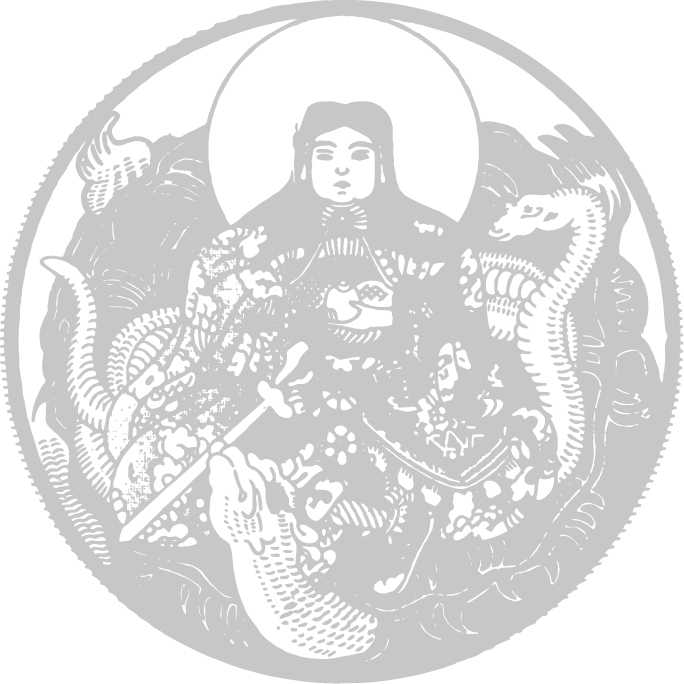
Chintaku Reifu Sonjin
Chintaku Reifu Sonjin—formally Taijo Chintaku Reifu Sonjin (太上鎮宅霊符尊神)—abides at the North Star, the heavenly center in which Taiitsu is manifest, and governs the Nine Stars through the revolution of the Big Dipper. This is the great deity of Hokushin, the northern celestial pivot, revered in Onmyodo as holding the sacred rank next after Taizan Fukun Okami.
The deity is transmitted as standing upon Genbu, the Black Tortoise. In Heaven, this immortal deity of the northern pivot governs the will of Heaven. On Earth, as the name Chintaku Reifu indicates, the deity calms and protects the home through sacred talismans and guards people from calamity.
The history of this worship reaches back to remote antiquity. According to documents of the Tsuchimikado family, the sacred object enshrined at Tensha Shrine has been worshiped since the reign of Empress Suiko—the age of Prince Shotoku.
This deity also governs divination. The fortune calendar of Tensha Shrine bears the deity’s image on its cover, and even today the deity receives especially deep reverence from many who practice the divinatory arts.
Abe no Seimei Okami
Abe no Seimei was descended from the line of the eighth emperor, Kogen, and left his name to later ages as the great master who brought Onmyodo to completion. Displaying extraordinary gifts from childhood, he mastered the principles of Taiitsu, yin and yang, and the Five Phases, and led the way of Heaven, Earth, yin and yang to its mature form.
Of particular importance in the history of Tensha Shrine is his bond with Taizan Fukun Okami—Taiitsu—whose transmission is associated with Abe no Nakamaro, revered as an ancestor of the Abe family.
The way of yin and yang and the calendar that Seimei mastered still lives with people today: in the seven-day cycle of sun, moon, fire, water, wood, metal and earth, and in annual observances such as New Year, Setsubun, the Tango Festival and Tanabata.
Tensha Shrine reveres and solemnly enshrines the divine spirit of Seimei as Abe no Seimei Okami.
Wakasa Kuzuha-hime Inari
This Inari deity is the princess revered as the mother of Abe no Seimei.
From ancient times, tradition has related that Seimei’s mother was a white fox of Shinoda Forest in Izumi Province. When her true form became known, she left the young Seimei and returned to the forest, leaving a poem at their parting:
If you long for me, come and seek me
in Izumi, in Shinoda Forest,
beneath the leaves of the arrowroot vine.恋しくば 尋ね来て見よ 和泉なる
信太の森の うらみ葛の葉
The word urami evokes both grief or resentment—the sorrow of one compelled to depart—and “looking behind,” an invitation to come and see the hidden form. The poem conveys a mother’s love for her child even after she became a divine spirit. Tradition says that Seimei inherited a more-than-human spiritual nature from this mother, remembered in the tale as Kuzuha, and the poem later came to be revered as divinely inspired.
The white fox is a messenger of Inari Okami. Through this sacred bond, Tensha Shrine prepares the calendar of Fushimi Inari Taisha, the head shrine of Inari worship.
Because she formed a bond with a human and bore a child, she grants blessings for children and harmony between husband and wife. Through the spiritual nature of the white fox inherited by Seimei, she bestows and strengthens spiritual power.
The Tsuchimikado family, descendants of Seimei, has worshiped this divine mother through successive generations.
Abe no Nakamaro
Abe no Nakamaro was a son of Abe no Funamori, an official of the Abe clan that claimed descent from Ohiko no Mikoto. In 717, while still under twenty years of age, he was selected as a student in a Japanese mission to Tang China and crossed the sea. Kibi no Makibi traveled in the same fleet. According to the Shoku Nihongi, before departure the party prayed for a safe voyage at the foot of Mount Mikasa in Kasuga.
In Tang China, Nakamaro used the name Chao Heng (朝衡). Tradition holds that he passed the imperial examination and served Emperor Xuanzong, rising to high offices including Director of the Palace Library and Protector-General of Annam. The Old Book of Tang records that he admired the ways of China and remained there, while the poets Wang Wei and Li Bai were his friends. Emperor Xuanzong, whom Nakamaro served, was also the emperor who performed the Fengshan rite at Mount Tai.
According to the history preserved at Tensha Shrine, while in Tang China Nakamaro received from sacred Mount Tai the sacred object of the supreme deity of Heaven, Dayuanzunshen—Taiitsu. With the great charge that it be transmitted to the Imperial House and the Abe family, he entrusted everything to Kibi no Makibi.
In 753, Nakamaro at last boarded a ship bound for Japan. At a farewell banquet on the coast of Mingzhou, he is said to have composed this poem:
Looking up across the vast plain of Heaven,
is that the same moon that rose
above Mount Mikasa in Kasuga?天の原 ふりさけ見れば 春日なる
三笠の山に 出でし月かも
Known to all as poem seven of the Hyakunin Isshu, its Mount Mikasa is the very mountain of Kasuga where the mission had prayed for safety on the day of departure thirty-six years earlier.
The ship, however, was driven off course by a storm and reached Annam. Only the second ship of the same fleet reached Japan; aboard it was the monk Jianzhen, known in Japan as Ganjin. Hearing the report of the wreck, Li Bai mourned his friend in a poem saying that the bright moon had not returned and had sunk into the blue sea. Nakamaro survived and returned to Chang’an, but another opportunity to return to Japan never came. He died in Chang’an in 770 after fifty-three years in Tang China.
People of later ages related that even after becoming a spirit, Nakamaro aided Makibi in China.
Nakamaro did not return, but what he entrusted did. The sacred object crossed the sea in Makibi’s hands, was protected by the Kamo family, passed to Abe no Yasuna and Seimei and then to the Tsuchimikado family. Thirteen centuries later, it remains enshrined at Tensha Shrine in Natasho, Wakasa.
Tensha Shrine worships Nakamaro—who through learning came to serve an emperor in a foreign land—as a deity of scholarship. He grants strength to those who pursue learning and to those who take on demanding examinations and trials.
Tensha Shrine also prepares the calendar of Kasuga Taisha, the shrine at the foot of Mount Mikasa where Nakamaro prayed before his departure and which he remembered in his poem of longing for home. This is a sacred bond extending across more than a thousand years.